
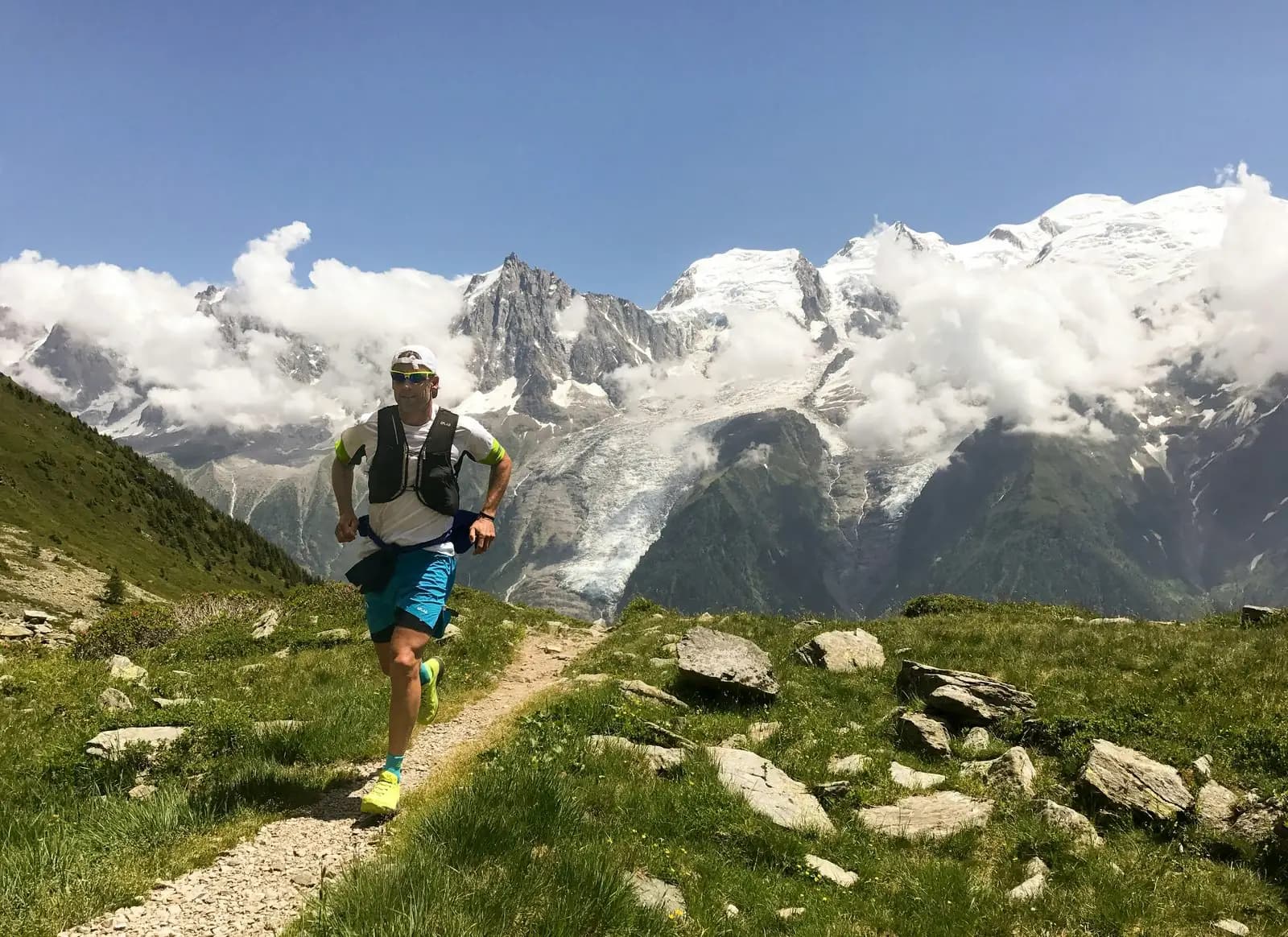
Saint-Étienne → Lyon · November 27, 2027 (date to be confirmed)

How to prepare for SaintéLyon 2027

A night race in late November from Saint-Étienne to Lyon: about 80 km on a course that changes every year, between the trails of the Monts du Lyonnais and the road.

  • 80 km
  • 2,500 m of climbing
  • 17 h cutoff
  • 6 formats
Prepare it with Leo

7 days free · cancel in one tap

The course in figures

SaintéLyon 80 kmHilly trail

Distance
80 km
Elevation gain
2,500 m
Climb per km
31 m
Flat-effort equivalent
105 km
Cutoff
17 h
Suggested build
18 weeks

LyonSaintéLyon 160 kmHilly trail

Distance
160 km
Elevation gain
5,000 m
Climb per km
31 m
Flat-effort equivalent
210 km
Cutoff
31 h 30 min
Suggested build
24 weeks

SaintExpress 46 kmHilly trail

Distance
46 km
Elevation gain
1,200 m
Climb per km
26 m
Flat-effort equivalent
58 km
Cutoff
17 h 30 min
Suggested build
16 weeks

SaintéVia 36 kmRunnable trail

Distance
36 km
Suggested build
16 weeks

SaintéSprint 25 kmRunnable trail

Distance
25 km
Elevation gain
470 m
Climb per km
19 m
Flat-effort equivalent
30 km
Suggested build
12 weeks

SaintéTic 13 kmRunnable trail

Distance
13 km
Elevation gain
280 m
Climb per km
22 m
Flat-effort equivalent
16 km
Suggested build
10 weeks

Race simulator

Average pace

7:53 /km

Flat-effort pace

6:00 /km

105.0 flat-effort km

PointPassing timeCutoff
Saint-Christo-en-Jarezkm 172:13:534:30:00
Sainte-Catherinekm 324:12:007:30:00
Saint-Genou - Le Camp (drinks only)km 466:02:1510:00:00
Soucieu-en-Jarrestkm 607:52:3012:30:00
Chaponostkm 678:47:3814:00:00

No climbing published per section: passing times are split by distance.

Planning heuristics (100 m of climbing ≈ 1 km flat; Riegel for predictions), not a guarantee: terrain, heat, night and fatigue all move real times.

The traps of this course

What catches runners out on this course, and what to do about it.

A whole night by headlamp

The start is at 23:30: you run the whole night after a full day awake, in the late-November cold. Alertness drops around 3 or 4 am, just as the course gets most wearing.

What to do: Rehearse at least one long night run with the same headlamp and layers, and plan something warm for the aid stations, where you cool down fast.

Short, repeated climbs

The elevation gain changes between editions (2,500 m on the 2026 page, "at least 2,000 m" according to the organiser), in short, repeated climbs rather than big passes. Trying to run them all gets expensive after Sainte-Catherine (km 32).

What to do: Walk the steep pitches decisively from the start, even when you feel fresh.

The road finish after Chaponost

From Chaponost (km 67) to Lyon, road and descents take over on worn legs. Every descent makes the quadriceps brake while lengthening, and this is where they give out: an unprepared runner loses more time in the last 15 km than on all the climbs.

What to do: Train your thighs to brake before race day.

Fixed clock-time cutoffs

The cutoffs are fixed clock times on Sunday, from 4:00 am at Saint-Christo-en-Jarez to 4:30 pm in Lyon, shared by every wave. A late wave therefore leaves you less margin.

1 / 4

What the build asks of you

Can you take it on? The peak week of our plans for this distance, by goal.

Free tools for this course

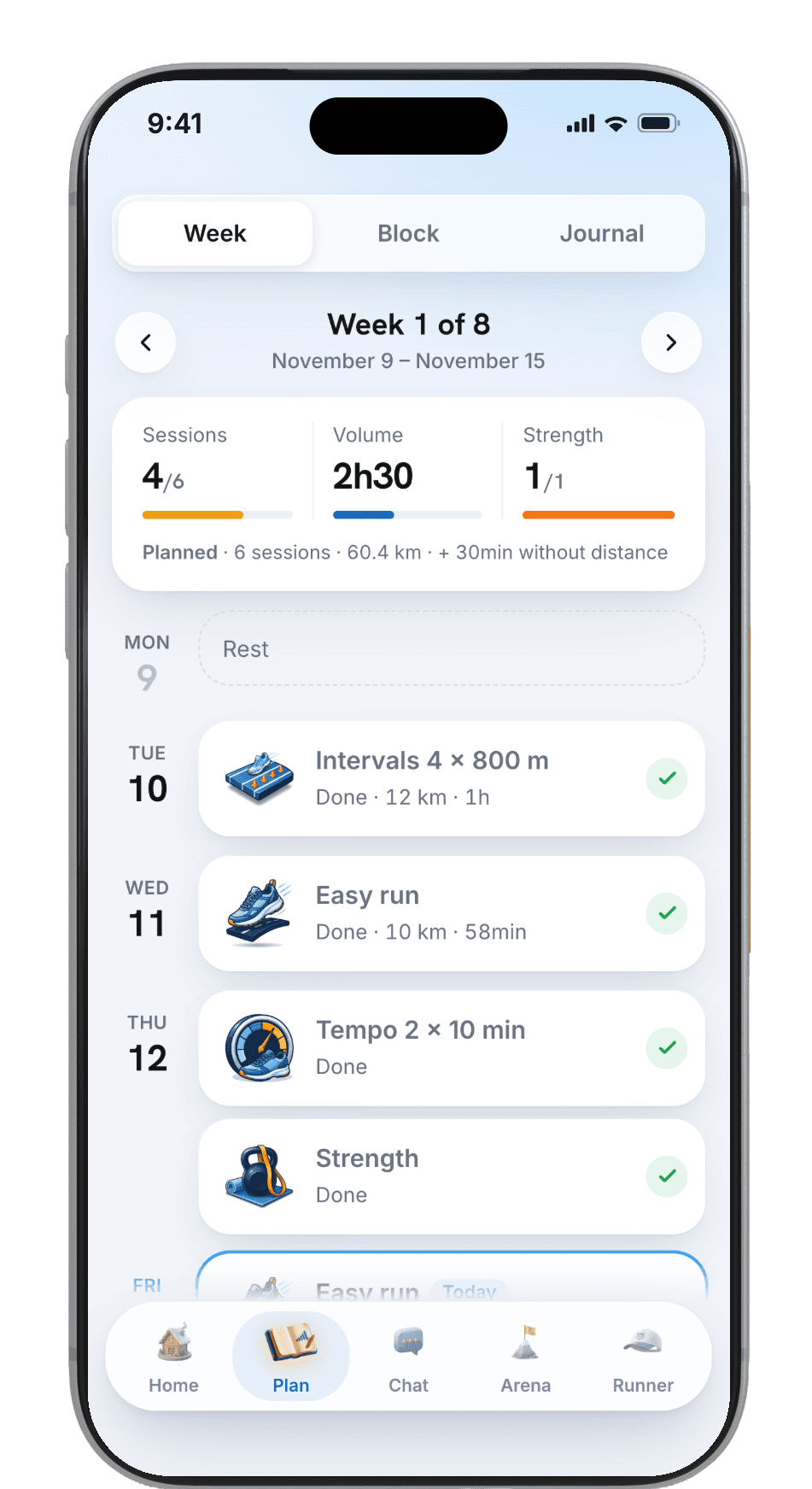
Leo builds your plan for this race

Tell him your goal and he starts from this course: its distance, its climbing, its date. Then he adapts every week to how you recover.

7 days free · cancel in one tap

Strength work and the key session

SaintéLyon 80 km

Strength work

Eccentric quadriceps work comes first, to absorb the downhill road finish: controlled step-downs, slow-lowering squats, reverse lunges, then progressively longer downhill runs in the last 6 weeks. Add core work to keep a clean stride as night fatigue sets in.

The key session

A long night run starting around 23:30 after a normal day: 4 to 5 hours on trails and road with your race headlamp and layers, finishing with road descents on tired legs.

LyonSaintéLyon 160 km

Strength work

The same eccentric base as the 80 km, with more downhill volume and ankle and foot strength to last twice the distance: calf raises, single-leg balance, light hops.

The key session

A two-part weekend that mirrors the outbound and return legs: a long day run, a few hours of rest and a meal, then a night run on legs already loaded, to learn to restart after the Saint-Étienne break.

Last results (2025)

winning time, men
5:36:33

Frequently asked questions

When is SaintéLyon 2027?

SaintéLyon 2027 takes place on November 27, 2027 (Saint-Étienne → Lyon), date still to be confirmed by the organiser.

What distances does SaintéLyon offer?

According to the organiser: SaintéLyon 80 km: 80 km, 2,500 m of climbing ; LyonSaintéLyon 160 km: 160 km, 5,000 m of climbing ; SaintExpress 46 km: 46 km, 1,200 m of climbing ; SaintéVia 36 km: 36 km ; SaintéSprint 25 km: 25 km, 470 m of climbing ; SaintéTic 13 km: 13 km, 280 m of climbing.

What is the time limit of SaintéLyon 80 km?

17 h to finish, per the published rules. Intermediate cutoffs also apply at aid stations: they are in the simulator above.

How many weeks to prepare for SaintéLyon 80 km?

Our plans for this distance last 18 weeks, starting from a regular running base. Weekly volumes and the longest run are detailed above.

Other races

Figures read on the organiser's material on November 10, 2026. Course details can change between editions: the organiser's page always wins. (course of the 2026 edition)

Sources