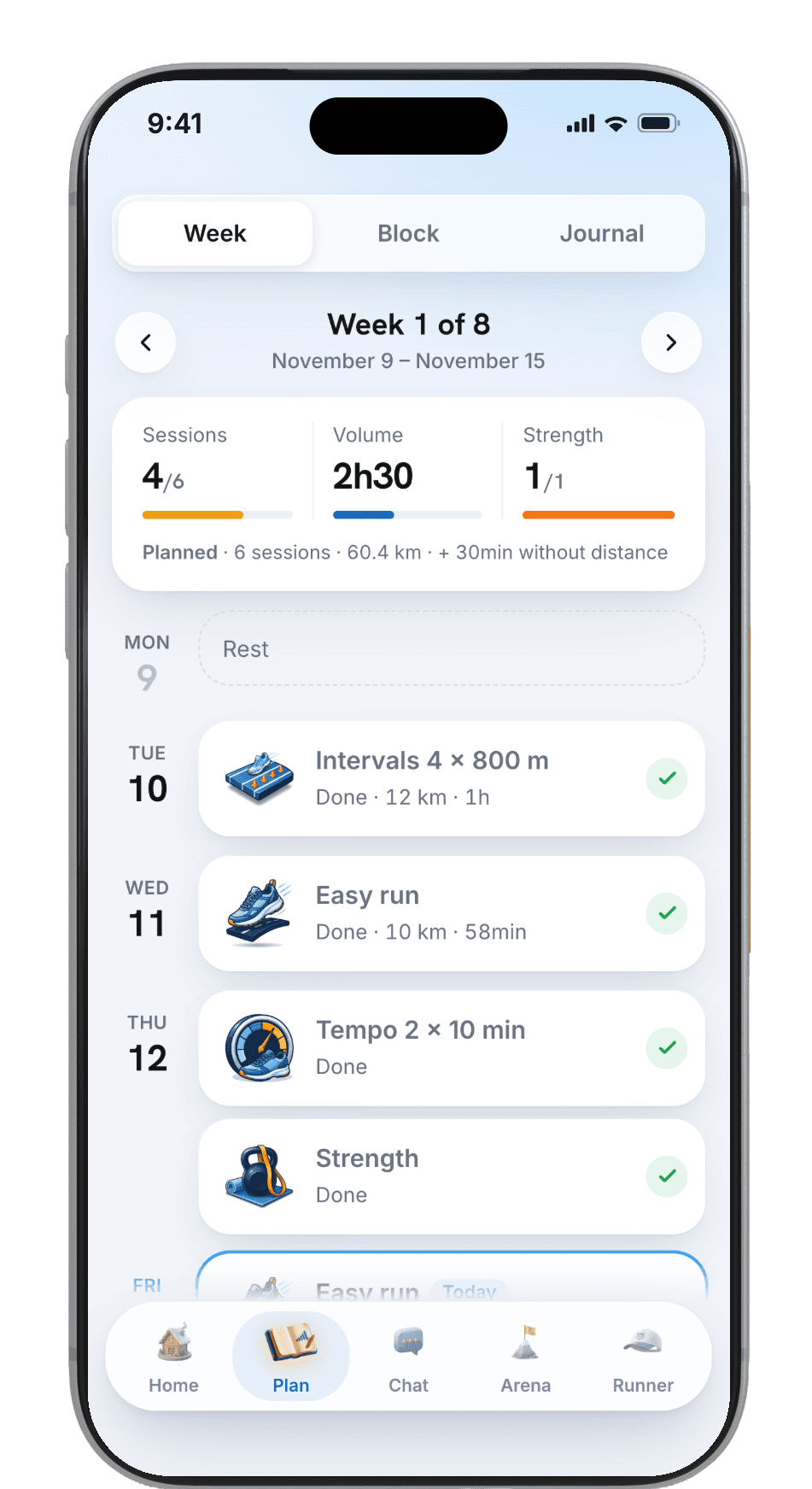
What the training week looks like
Three or four runs for 25 to 35 km. Two easy runs, one session with faster efforts, and a long run of 10 km. The whole block takes about three hours a week, which is why it is the most completable plan on this page.

The plan week by week, free to read here or as a PDF. With Leo, yours is written from your own runs.
Tap a week to see its sessions.
Enter a recent race. We check it against this plan's starting level.
TL;DR
Run a 25:00 5K with a 8-week structured plan. Peak weekly volume 25-35 km, 3-4 runs per week, goal pace 5:00/km. Pre-requisite: a recent 5K in 28:00. With Leo, your plan is written from your training history, then adjusted week after week.
25 minutes for 5k, at 5:00/km, is the goal that most often marks the shift from running for health to running for performance. The pace is round, memorable, and just fast enough that you have to pay attention throughout.
Targeting 25:00 requires a baseline of current running fitness. The most reliable signal: a recent 5K you can run in 28:00 or under. If you are below this level, start with a less aggressive goal — running too fast in training is the #1 cause of injury at this level.
These paces are computed from an Endurance Index of 38 (the physiological ceiling for your goal). Every session in the plan falls into one of these zones — never random.
Every credible training plan follows a four-phase progression: base, build, peak, taper. The phase durations adapt to the distance and the runner's level. Here is the split for this plan.
Every plan needs three workout types per week (or every 10 days at lower volumes). These are the sessions that actually move the needle — the rest is supportive easy running.
Warm up with 15 minutes easy around 6:40/km and three strides. The main set is 400 m repeats in 1:46 to 1:49, which is 4:25 to 4:32/km, the plan's repetition zone, each followed by 400 m of walking or very easy jogging, about three minutes. Cool down with 10 minutes easy. It starts with six repeats in week 2, reaches eight in week 4 and stays at eight in the peak weeks. The recovery is long on purpose: this session is about speed and form, not fatigue. Most runners aiming at 25 minutes almost never run faster than 5:30/km. After a few weeks of 400 m at 4:25 to 4:30, 5:00 becomes a pace you run below your top gear instead of right at it.
Every session, day by day. Expand a week to see it. Paces and durations are those of the sample plan: with Leo, they start from your own runs.
| Mon | Rest | Full rest or cross-training |
| Tue | Rest | Full rest or cross-training |
| Wed | Easy | 7 km easy @ 6:04–7:22/km + 6 × 20 s strides |
| Thu | Rest | Full rest or cross-training |
| Fri | Rest | Full rest or cross-training |
| Sat | Easy | 6 km easy @ 6:04–7:22/km |
| Sun | Long | 10 km steady @ 6:04–7:22/km |
Something comes up this week, or your paces change? With Leo, the plan follows your runs, from your watch or Strava. Try 7 days free →
| Mon | Rest | Full rest or cross-training |
| Tue | Threshold | Warm-up + 3–4 × 8 min @ threshold 5:12–5:26/km (90 s jog) + cool-down |
| Wed | Rest | Full rest or cross-training |
| Thu | Intervals | Warm-up + 6–8 × 400–600 m @ 4:47–4:53/km, equal jog + cool-down |
| Fri | Rest | Full rest or cross-training |
| Sat | Rest | Full rest or cross-training |
| Sun | Long | 10 km steady @ 6:04–7:22/km |
Something comes up this week, or your paces change? With Leo, the plan follows your runs, from your watch or Strava. Try 7 days free →
| Mon | Rest | Full rest or cross-training |
| Tue | Threshold | Warm-up + 3–4 × 8 min @ threshold 5:12–5:26/km (90 s jog) + cool-down |
| Wed | Recovery | 5 km very easy @ 7:22/km, or rest |
| Thu | Intervals | Warm-up + 6–8 × 400–600 m @ 4:47–4:53/km, equal jog + cool-down |
| Fri | Rest | Full rest or cross-training |
| Sat | Rest | Full rest or cross-training |
| Sun | Long | 10 km steady @ 6:04–7:22/km |
Something comes up this week, or your paces change? With Leo, the plan follows your runs, from your watch or Strava. Try 7 days free →
| Mon | Rest | Full rest or cross-training |
| Tue | Intervals | Warm-up + 6–8 × 400–600 m @ 4:47–4:53/km, equal jog + cool-down |
| Wed | Recovery | 5 km very easy @ 7:22/km, or rest |
| Thu | Reps | Warm-up + 8–10 × 200–300 m @ 4:21–4:34/km, full recovery + cool-down |
| Fri | Rest | Full rest or cross-training |
| Sat | Rest | Full rest or cross-training |
| Sun | Long | 10 km steady @ 6:04–7:22/km |
Something comes up this week, or your paces change? With Leo, the plan follows your runs, from your watch or Strava. Try 7 days free →
| Mon | Rest | Full rest or cross-training |
| Tue | Intervals | Warm-up + 4–5 × 400 m @ 4:47–4:53/km (sharp, short) + cool-down |
| Wed | Easy | 5 km easy @ 6:04–7:22/km |
| Thu | Rest | Full rest or cross-training |
| Fri | Rest | Full rest or cross-training |
| Sat | Rest | Full rest or cross-training |
| Sun | Long | Goal race — execute your pace plan. |
Something comes up this week, or your paces change? With Leo, the plan follows your runs, from your watch or Strava. Try 7 days free →
These are the recurring errors we see in runners aiming for 25:00. Avoiding them is often the difference between PR and DNF.
The target is 5:00 per kilometre, 2:00 per 400 m, and 12:30 at halfway. At this level, two opposite mistakes cost the most. The first is skipping the warm-up entirely: the first kilometre then feels awful, breathing is ragged by 600 m, and many runners panic and back off to 5:20. Ten minutes of easy jogging and three strides, finished just before you line up, take that shock away. The second is the reverse, running the first kilometre in 4:40 because it suddenly feels easy. Aim for 4:58 to 5:02 on the first split and make the effort steady through the third kilometre. Only from 4 km onwards should you let the pace climb.
| Checkpoint | Time |
|---|---|
| 1 km | 5:00 |
| 2 km | 10:00 |
| 3 km | 15:00 |
| 4 km | 20:00 |
| 5 km | 25:00 |
Three runs a week is enough for this goal, four if your schedule allows it. With three, one is the 400 m session, one is an easy run, and one is the long run of up to 10 km. Adding a fourth run brings more gain than adding a second hard session, provided it stays easy, between 6:04 and 7:22 per kilometre.
5:00 per kilometre, which is 2:00 per 400 m on a track or 12 km/h on a treadmill. Halfway comes at 12:30. Round numbers make this goal easy to check during the race. One small precaution: on a treadmill, set a 1 percent incline to make up for the missing air resistance, otherwise 12 km/h indoors will feel easier than 5:00 per kilometre outdoors.
Not every week. A timed 5k at full effort is a hard session, and adding it to the 400 m repeats doubles the intensity in a three or four-run week. Use one as a test every three weeks, for example in weeks 3 and 6, and run the others easily with friends. Racing it flat out every Saturday tends to stall progress short of the goal.
This sample plan draws on the principles of the major training methods, documented and tested over decades:
Leo Training does not replace medical advice. Consult a sports physician before starting any new training plan, especially after an injury or extended break.

This plan is the same for everyone. Leo writes yours from your runs, your week and your goal, then adjusts it when life gets in the way: a missed session, a tiring week, a trip.
7 days free, then from 6.67/month (yearly) or 9.99/month. Cancel in one tap.