Enter a recent race. We check it against this plan's starting level.
Your time
hmins
TL;DR
Run a Sub-3:00 Marathon with a 16-week structured plan. Peak weekly volume 85-110 km, 6-7 runs per week, goal pace 4:15/km. Pre-requisite: a recent 10K in 38:00. With Leo, your plan is written from your training history, then adjusted week after week.
What a Sub-3:00 actually asks of you
Sub-3 is not a quicker version of a 3:15 build. It is a different sport. Holding 4:15/km for 42 km requires that pace to feel genuinely conversational by week 12, and that only happens on weekly volume most amateur runners never reach.
What the training week looks like
Six or seven runs for 85 to 110 km, which is 8 to 10 hours a week once you count warm-ups and strides. You will run most days on legs that are not fresh. The easy runs sit around 5:20 to 6:00/km and must stay there, because two sessions a week are genuinely hard.
What actually limits you at this level
Almost nobody misses sub-3 on raw speed. They miss it between km 32 and 38, when marathon pace quietly stops being aerobic. The answer is marathon-pace volume inside long runs rather than more intervals, so the peak long runs here carry up to 25 km at 4:15/km.
If you are not at a 10K in 38:00 yet
Below a 38:00 10k, sub-3 in 16 weeks is a coin flip and the downside is losing the whole race. Build to 3:05 or 3:10 first, then come back with a bigger aerobic base. A missed sub-3 costs a season; a 3:05 buys you the next one.
1 / 3
Are you ready for a Sub-3:00 plan?
Targeting Sub-3:00 requires a baseline of current running fitness. The most reliable signal: a recent 10K you can run in 38:00 or under. If you are below this level, start with a less aggressive goal — running too fast in training is the #1 cause of injury at this level.
Recent 10K time (or current ability)
38:00
Equivalent Endurance Index
54
Profile
Elite — high-mileage athlete
Target training paces
These paces are computed from an Endurance Index of 54 (the physiological ceiling for your goal). Every session in the plan falls into one of these zones — never random.
Easy4:34–5:33/kmAerobic base, recovery between hard days
Every credible training plan follows a four-phase progression: base, build, peak, taper. The phase durations adapt to the distance and the runner's level. Here is the split for this plan.
2 weeks
Base
2 weeks establishing the aerobic foundation. Mostly easy running, no real intensity. Goal: get the legs moving consistently and build a weekly rhythm.
6 weeks
Build
6 weeks introducing quality work — intervals, threshold runs, hill repeats. Volume increases gradually. This is where fitness starts to break upward.
5 weeks
Peak
5 weeks of race-specific work. Long runs reach maximum distance, marathon-pace work appears in long runs, hardest sessions of the cycle. Mental and physical stress peak here.
3 weeks
Taper
3 weeks of reduced volume (40-60% less). Some intensity stays to keep the legs sharp. Glycogen restores, micro-damage heals, confidence builds.
1 / 4
Three key workouts in this plan
Every plan needs three workout types per week (or every 10 days at lower volumes). These are the sessions that actually move the needle — the rest is supportive easy running.
Long run
Build progressively up to 35 km, run at easy pace (4:34–5:33 per km). This is the cornerstone session — never skip it, never race it. The point is time on feet at low intensity, not speed.
VO2max intervals
Example: 6×800m at interval pace (3:36–3:41 per km), with 90-second jog recovery between reps. Builds aerobic ceiling and running economy. Once per week, never in back-to-back days.
Threshold / Race-pace tempo
20-40 minutes continuous at threshold pace (3:55–4:06 per km), or progressive long runs ending at goal pace (4:15/km). Builds lactate clearance and race-pace efficiency. The most race-specific session of the week.
1 / 3
The session that makes this goal
16 km of alternating kilometres
Warm up with 3 km easy at 5:00 to 5:15/km and four strides. Then run 16 km without stopping, alternating one kilometre at 4:00 to 4:04/km (threshold) and one kilometre at 4:22 to 4:26/km, the slow side of marathon pace. Cool down with 2 km easy. The session appears in the peak phase, roughly weeks 9 to 12, once the build phase has taken you through threshold reps of 2 to 3 km. Why this one: at sub-3 your 'recovery' kilometre is faster than most runners' race pace, so you learn to clear lactate while still moving at 4:25/km. That is exactly what 4:15/km asks of you after km 30: no rest, only a slightly gentler gear.
Week-by-week plan
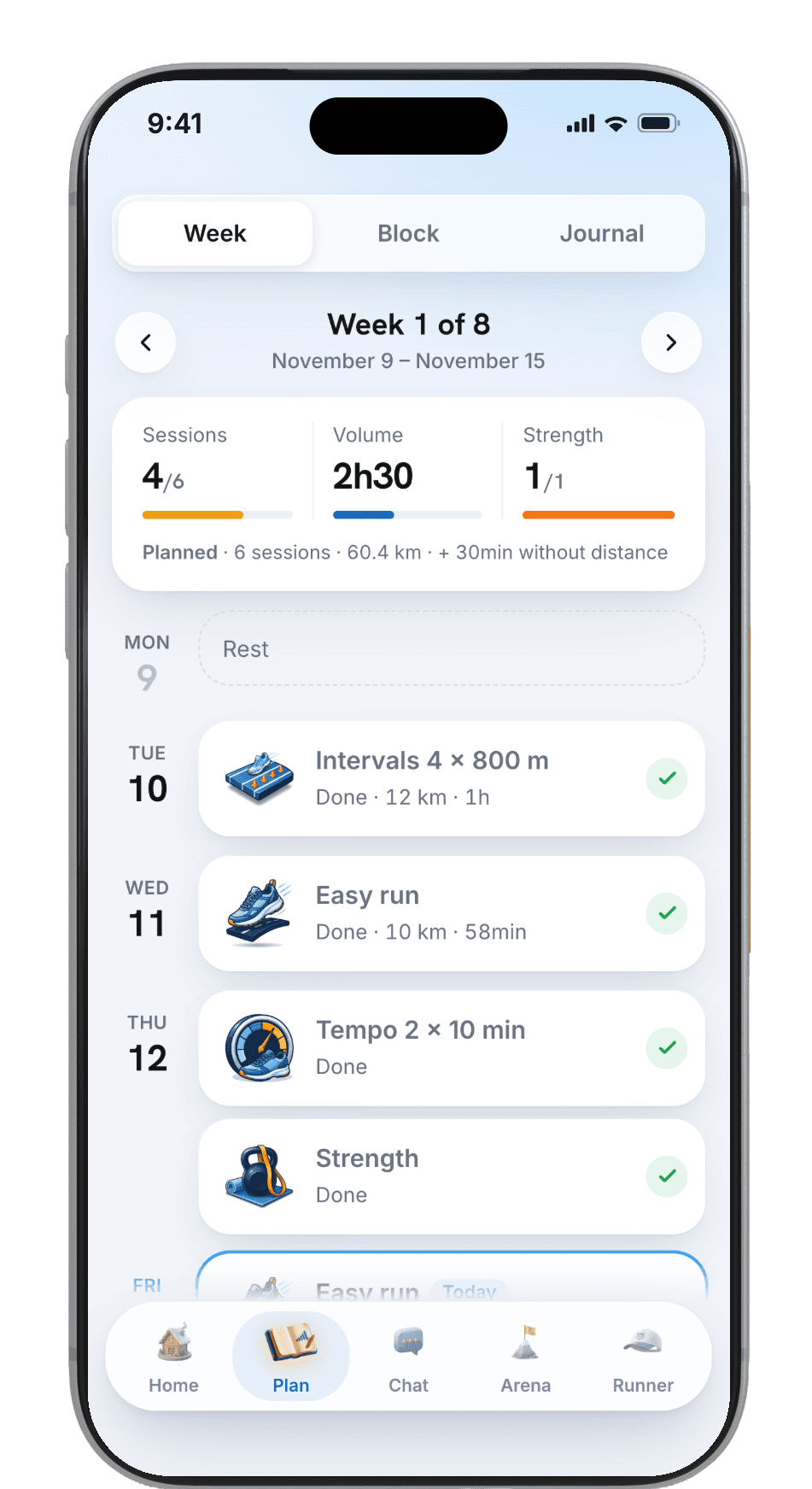
Every session, day by day. Expand a week to see it. Paces and durations are those of the sample plan: with Leo, they start from your own runs.
Base · Week 159 km
Mon
Easy
9 km easy @ 4:34–5:33/km
Tue
Rest
Full rest or cross-training
Wed
Easy
8 km easy @ 4:34–5:33/km
Thu
Rest
Full rest or cross-training
Fri
Easy
8 km easy @ 4:34–5:33/km
Sat
Easy
9 km easy @ 4:34–5:33/km
Sun
Long
17 km steady @ 4:34–5:33/km
Something comes up this week, or your paces change? With Leo, the plan follows your runs, from your watch or Strava. Try 7 days free →
Base · Week 274 km
Mon
Easy
11 km easy @ 4:34–5:33/km
Tue
Rest
Full rest or cross-training
Wed
Easy
11 km easy @ 4:34–5:33/km + 6 × 20 s strides
Thu
Rest
Full rest or cross-training
Fri
Easy
11 km easy @ 4:34–5:33/km
Sat
Easy
11 km easy @ 4:34–5:33/km
Sun
Long
19 km steady @ 4:34–5:33/km
Something comes up this week, or your paces change? With Leo, the plan follows your runs, from your watch or Strava. Try 7 days free →
Build · Week 374 km
Mon
Rest
Full rest or cross-training
Tue
Threshold
Warm-up + 3–4 × 8 min @ threshold 3:55–4:06/km (90 s jog) + cool-down
Wed
Recovery
11 km very easy @ 5:33/km, or rest
Thu
Intervals
Warm-up + 5–6 × 1000 m @ 3:36–3:41/km, equal jog recovery + cool-down
Fri
Easy
10 km easy @ 4:34–5:33/km
Sat
Easy
11 km easy @ 4:34–5:33/km
Sun
Long
20 km steady @ 4:34–5:33/km
Something comes up this week, or your paces change? With Leo, the plan follows your runs, from your watch or Strava. Try 7 days free →
Build · Week 4deload (recovery week)63 km
Mon
Rest
Full rest or cross-training
Tue
Threshold
Warm-up + 3–4 × 8 min @ threshold 3:55–4:06/km (90 s jog) + cool-down
Wed
Recovery
6 km very easy @ 5:33/km, or rest
Thu
Intervals
Warm-up + 5–6 × 1000 m @ 3:36–3:41/km, equal jog recovery + cool-down
Fri
Easy
6 km easy @ 4:34–5:33/km
Sat
Easy
7 km easy @ 4:34–5:33/km
Sun
Long
22 km steady @ 4:34–5:33/km
Something comes up this week, or your paces change? With Leo, the plan follows your runs, from your watch or Strava. Try 7 days free →
Build · Week 579 km
Mon
Easy
8 km easy @ 4:34–5:33/km
Tue
Threshold
Warm-up + 3–4 × 8 min @ threshold 3:55–4:06/km (90 s jog) + cool-down
Wed
Recovery
9 km very easy @ 5:33/km, or rest
Thu
Intervals
Warm-up + 5–6 × 1000 m @ 3:36–3:41/km, equal jog recovery + cool-down
Fri
Easy
9 km easy @ 4:34–5:33/km
Sat
Easy
8 km easy @ 4:34–5:33/km
Sun
Long
23 km steady @ 4:34–5:33/km
Something comes up this week, or your paces change? With Leo, the plan follows your runs, from your watch or Strava. Try 7 days free →
Build · Week 682 km
Mon
Easy
8 km easy @ 4:34–5:33/km
Tue
Threshold
Warm-up + 3–4 × 8 min @ threshold 3:55–4:06/km (90 s jog) + cool-down
Wed
Recovery
9 km very easy @ 5:33/km, or rest
Thu
Intervals
Warm-up + 5–6 × 1000 m @ 3:36–3:41/km, equal jog recovery + cool-down
Fri
Easy
9 km easy @ 4:34–5:33/km
Sat
Easy
9 km easy @ 4:34–5:33/km
Sun
Long
25 km steady @ 4:34–5:33/km
Something comes up this week, or your paces change? With Leo, the plan follows your runs, from your watch or Strava. Try 7 days free →
Build · Week 785 km
Mon
Easy
9 km easy @ 4:34–5:33/km
Tue
Threshold
Warm-up + 3–4 × 8 min @ threshold 3:55–4:06/km (90 s jog) + cool-down
Wed
Recovery
9 km very easy @ 5:33/km, or rest
Thu
Intervals
Warm-up + 5–6 × 1000 m @ 3:36–3:41/km, equal jog recovery + cool-down
Fri
Easy
10 km easy @ 4:34–5:33/km
Sat
Easy
9 km easy @ 4:34–5:33/km
Sun
Long
26 km steady @ 4:34–5:33/km
Something comes up this week, or your paces change? With Leo, the plan follows your runs, from your watch or Strava. Try 7 days free →
Build · Week 8deload (recovery week)72 km
Mon
Easy
5 km easy @ 4:34–5:33/km
Tue
Threshold
Warm-up + 3–4 × 8 min @ threshold 3:55–4:06/km (90 s jog) + cool-down
Wed
Recovery
6 km very easy @ 5:33/km, or rest
Thu
Intervals
Warm-up + 5–6 × 1000 m @ 3:36–3:41/km, equal jog recovery + cool-down
Fri
Easy
6 km easy @ 4:34–5:33/km
Sat
Easy
5 km easy @ 4:34–5:33/km
Sun
Long
28 km steady @ 4:34–5:33/km
Something comes up this week, or your paces change? With Leo, the plan follows your runs, from your watch or Strava. Try 7 days free →
Peak · Week 990 km
Mon
Easy
10 km easy @ 4:34–5:33/km
Tue
Threshold
Warm-up + 3–4 × 8 min @ threshold 3:55–4:06/km (90 s jog) + cool-down
Wed
Recovery
10 km very easy @ 5:33/km, or rest
Thu
Rest
Full rest or cross-training
Fri
Easy
10 km easy @ 4:34–5:33/km
Sat
Easy
10 km easy @ 4:34–5:33/km
Sun
Long
29 km easy (@ 4:34–5:33/km) finishing with 9 km @ marathon pace 4:08–4:30/km
Something comes up this week, or your paces change? With Leo, the plan follows your runs, from your watch or Strava. Try 7 days free →
Peak · Week 1092 km
Mon
Easy
10 km easy @ 4:34–5:33/km
Tue
Threshold
Warm-up + 3–4 × 8 min @ threshold 3:55–4:06/km (90 s jog) + cool-down
Wed
Recovery
10 km very easy @ 5:33/km, or rest
Thu
Rest
Full rest or cross-training
Fri
Easy
10 km easy @ 4:34–5:33/km
Sat
Easy
10 km easy @ 4:34–5:33/km
Sun
Long
31 km easy (@ 4:34–5:33/km) finishing with 9 km @ marathon pace 4:08–4:30/km
Something comes up this week, or your paces change? With Leo, the plan follows your runs, from your watch or Strava. Try 7 days free →
Peak · Week 1194 km
Mon
Easy
11 km easy @ 4:34–5:33/km
Tue
Threshold
Warm-up + 3–4 × 8 min @ threshold 3:55–4:06/km (90 s jog) + cool-down
Wed
Recovery
10 km very easy @ 5:33/km, or rest
Thu
Rest
Full rest or cross-training
Fri
Easy
10 km easy @ 4:34–5:33/km
Sat
Easy
10 km easy @ 4:34–5:33/km
Sun
Long
32 km easy (@ 4:34–5:33/km) finishing with 10 km @ marathon pace 4:08–4:30/km
Something comes up this week, or your paces change? With Leo, the plan follows your runs, from your watch or Strava. Try 7 days free →
Peak · Week 1296 km
Mon
Easy
11 km easy @ 4:34–5:33/km
Tue
Threshold
Warm-up + 3–4 × 8 min @ threshold 3:55–4:06/km (90 s jog) + cool-down
Wed
Recovery
10 km very easy @ 5:33/km, or rest
Thu
Rest
Full rest or cross-training
Fri
Easy
10 km easy @ 4:34–5:33/km
Sat
Easy
10 km easy @ 4:34–5:33/km
Sun
Long
34 km easy (@ 4:34–5:33/km) finishing with 10 km @ marathon pace 4:08–4:30/km
Something comes up this week, or your paces change? With Leo, the plan follows your runs, from your watch or Strava. Try 7 days free →
Peak · Week 1398 km
Mon
Easy
11 km easy @ 4:34–5:33/km
Tue
Threshold
Warm-up + 3–4 × 8 min @ threshold 3:55–4:06/km (90 s jog) + cool-down
Wed
Recovery
10 km very easy @ 5:33/km, or rest
Thu
Rest
Full rest or cross-training
Fri
Easy
10 km easy @ 4:34–5:33/km
Sat
Easy
11 km easy @ 4:34–5:33/km
Sun
Long
35 km easy (@ 4:34–5:33/km) finishing with 11 km @ marathon pace 4:08–4:30/km
Something comes up this week, or your paces change? With Leo, the plan follows your runs, from your watch or Strava. Try 7 days free →
Something comes up this week, or your paces change? With Leo, the plan follows your runs, from your watch or Strava. Try 7 days free →
Common mistakes when targeting Sub-3:00
These are the recurring errors we see in runners aiming for Sub-3:00. Avoiding them is often the difference between PR and DNF.
01
Running easy days too fast. Your easy pace should feel conversational (4:15/km is your race pace — easy is much slower). Running easy days at marathon pace burns you out without aerobic adaptation gain.
02
Skipping the taper. The last 2-3 weeks of reduced volume are not 'rest' — they are when adaptation consolidates and glycogen restores. Adding miles in the taper is the most common pre-race mistake.
03
Treating the long run as a competition. The long run builds endurance, not race-day capability. Keep it relaxed (slow side of easy pace). If you are 'spent' the day after, you ran it too fast.
04
Stacking intensity to compensate for missed sessions. If you miss a session, let it go. Trying to 'make it up' next week by doubling intensity is the fastest path to injury at this level.
05
Underestimating recovery between hard sessions. Plan at least two easy or rest days between intensity workouts (intervals, threshold, marathon pace). The 'cumulative fatigue' Hansons approach is the only exception, and it's only for advanced runners.
1 / 5
Race day: Marathon in Sub-3:00
Plan on 4:13 to 4:14/km, not 4:15. Most city courses read 42.4 to 42.6 km on a watch because nobody runs perfect tangents, and 300 m at this pace costs over a minute — the margin between 2:59 and 3:00:40. Take your checkpoints from the course markers: 10 km in 42:15, halfway in 1:29:10, 30 km in 2:06:45, then hold. Take a gel every 25 minutes from minute 25, six in all, and a few mouthfuls at every station; at this speed they arrive every 21 minutes. The classic sub-3 mistake happens between km 30 and 35, when the pack you have sheltered in all morning breaks up. Find the next group before you lose this one, not after.
Even-pace split times (4:15/km)
Checkpoint
Time
5 km
21:20
10 km
42:39
15 km
1:03:59
20 km
1:25:19
Half (21.1 km)
1:30:00
25 km
1:46:38
30 km
2:07:58
35 km
2:29:18
40 km
2:50:37
42.195 km
2:59:59
Frequently asked questions
Do I need to run twice a day to break 3 hours?
Not necessarily. The plan asks for 85 to 110 km over six or seven runs, which most runners cover with single runs of 10 to 18 km plus a long run of up to 35 km. Doubles make sense in peak weeks above 100 km, when an evening 6 km jog is gentler on the legs than stretching a morning run to 20 km. If you can only run once a day, stay at the lower end of the volume range.
Is training for 3:00 flat any different from training for sub-3?
Not in training: the two paces are one second per kilometre apart, so the sessions, the long runs and the volume stay the same. The difference is on race day. Aiming at 2:59 gives you a planned cushion of 30 to 60 seconds for GPS drift and crowded aid stations; aiming at 3:00 flat leaves none. If three hours is your goal, pace the race as a sub-3 attempt anyway and let the last kilometre decide.
Can I break 3 hours in my first marathon?
It happens, but almost always to runners who arrive with years of 10k and half-marathon racing behind them, a 10k near 37 minutes and a long history of 70 km weeks. What a first marathon cannot tell you in advance is how your legs behave after km 32. If this is your first, run 3:05 to 3:10 with an even second half. It gives you a real reference to build the next sub-3 block on.
Sources & methodology
This sample plan draws on the principles of the major training methods, documented and tested over decades:
Pete Pfitzinger — Advanced Marathoning (3rd ed., 2019)
Leo Training does not replace medical advice. Consult a sports physician before starting any new training plan, especially after an injury or extended break.
This plan is the same for everyone. Leo writes yours from your runs, your week and your goal, then adjusts it when life gets in the way: a missed session, a tiring week, a trip.