Enter a recent race. We check it against this plan's starting level.
Your time
hmins
TL;DR
Run a 20:00 5K with a 8-week structured plan. Peak weekly volume 35-50 km, 4-5 runs per week, goal pace 4:00/km. Pre-requisite: a recent 5K in 23:00. With Leo, your plan is written from your training history, then adjusted week after week.
What a 20:00 actually asks of you
Twenty minutes flat is 4:00/km for five kilometres, and it is the most attempted time barrier in the sport. One second per kilometre separates it from sub-20, which means the difference is entirely in the final 400 metres and how much you have left for them.
What the training week looks like
Four or five runs for 35 to 50 km. Two quality sessions and two or three easy runs. At 5k specialisation the easy runs are not filler: they are what allows the interval sessions to be run at genuine quality rather than at a compromised pace.
What actually limits you at this level
The limiter is finishing speed. Runners with 20:00 fitness often run 20:15 because they have never practised the final kilometre at maximum effort on tired legs. Broken sessions ending with 3 × 400 m flat out are the specific antidote in this plan.
If you are not at a 5K in 23:00 yet
A 23:00 5k puts 20:00 in reach across eight weeks. If you are starting from a base of easy running with no speed work at all, expect most of the gain to come in weeks four to seven, once your body has adapted to the interval load.
1 / 3
Are you ready for a 20:00 plan?
Targeting 20:00 requires a baseline of current running fitness. The most reliable signal: a recent 5K you can run in 23:00 or under. If you are below this level, start with a less aggressive goal — running too fast in training is the #1 cause of injury at this level.
Recent 5K time (or current ability)
23:00
Equivalent Endurance Index
50
Profile
Intermediate — experienced runner
Target training paces
These paces are computed from an Endurance Index of 50 (the physiological ceiling for your goal). Every session in the plan falls into one of these zones — never random.
Easy4:51–5:54/kmAerobic base, recovery between hard days
Every credible training plan follows a four-phase progression: base, build, peak, taper. The phase durations adapt to the distance and the runner's level. Here is the split for this plan.
1 week
Base
1 week establishing the aerobic foundation. Mostly easy running, no real intensity. Goal: get the legs moving consistently and build a weekly rhythm.
3 weeks
Build
3 weeks introducing quality work — intervals, threshold runs, hill repeats. Volume increases gradually. This is where fitness starts to break upward.
3 weeks
Peak
3 weeks of race-specific work. Long runs reach maximum distance, marathon-pace work appears in long runs, hardest sessions of the cycle. Mental and physical stress peak here.
1 week
Taper
1 week of reduced volume (40-60% less). Some intensity stays to keep the legs sharp. Glycogen restores, micro-damage heals, confidence builds.
1 / 4
Three key workouts in this plan
Every plan needs three workout types per week (or every 10 days at lower volumes). These are the sessions that actually move the needle — the rest is supportive easy running.
Long run
Build progressively up to 14 km, run at easy pace (4:51–5:54 per km). This is the cornerstone session — never skip it, never race it. The point is time on feet at low intensity, not speed.
VO2max intervals
Example: 6×800m at interval pace (3:50–3:55 per km), with 90-second jog recovery between reps. Builds aerobic ceiling and running economy. Once per week, never in back-to-back days.
Threshold / Race-pace tempo
20-40 minutes continuous at threshold pace (4:10–4:21 per km), or progressive long runs ending at goal pace (4:00/km). Builds lactate clearance and race-pace efficiency. The most race-specific session of the week.
1 / 3
The session that makes this goal
12 × 400 m in 1:33-1:34, 45 seconds recovery
Warm up with 15 minutes easy around 5:20/km, a few drills and four strides. The main set is 400 m repeats in 1:33 to 1:34, which is 3:52 to 3:55/km, the plan's interval zone, with only 45 seconds of standing or walking recovery. Cool down with 10 minutes easy. It runs through the peak phase: eight repeats in week 5, ten in week 6, twelve in week 7. Twenty minutes for 5k is 1:36 per 400 m, twelve and a half times in a row. With 45 seconds between reps your heart rate never really drops, so the session rehearses the race itself, two or three seconds per lap quicker than you need. If you are chasing sub-20 rather than 20:00 flat, hold 1:33 on every rep, including the last.
Week-by-week plan
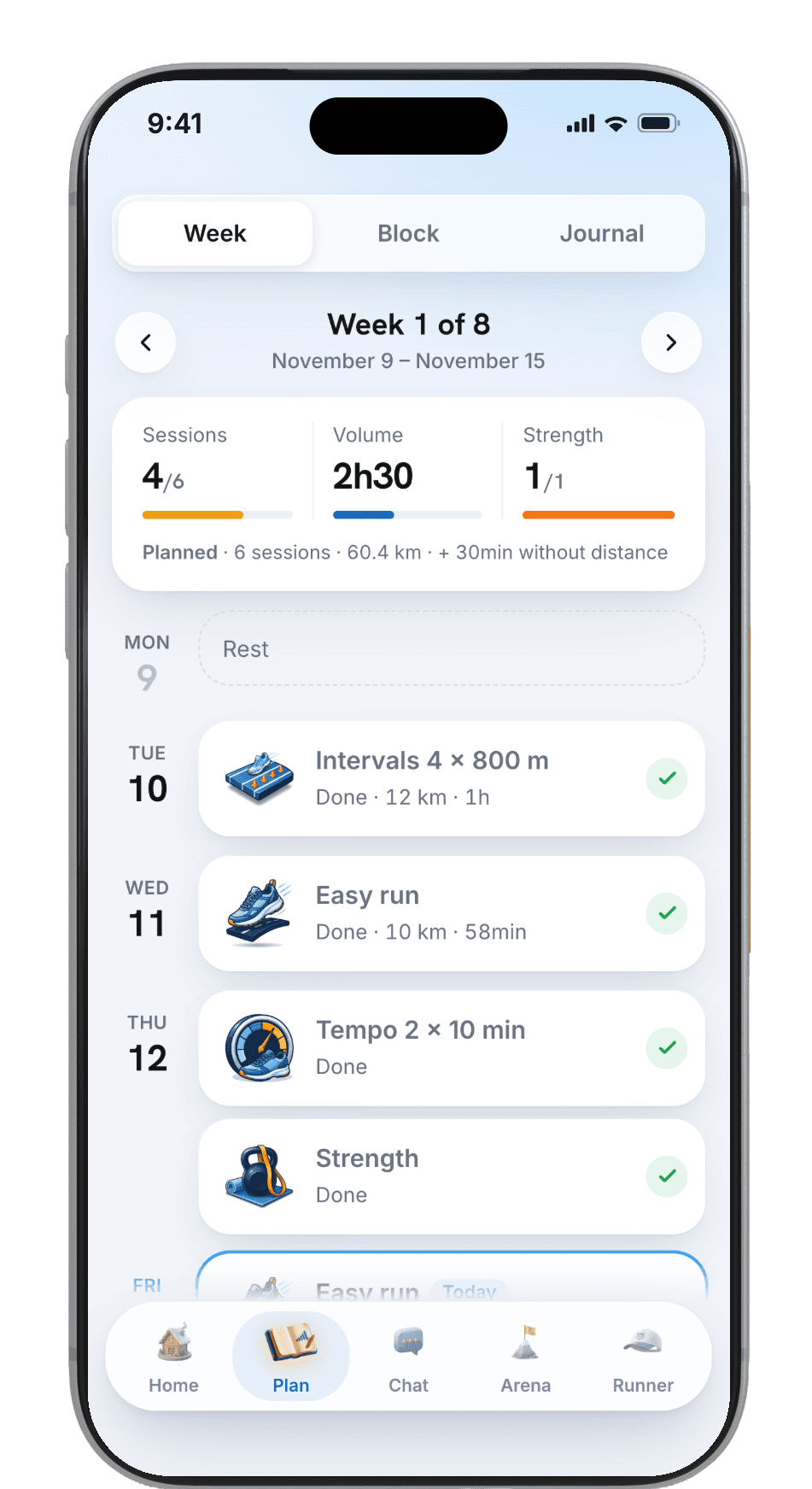
Every session, day by day. Expand a week to see it. Paces and durations are those of the sample plan: with Leo, they start from your own runs.
Base · Week 132 km
Mon
Rest
Full rest or cross-training
Tue
Rest
Full rest or cross-training
Wed
Easy
7 km easy @ 4:51–5:54/km + 6 × 20 s strides
Thu
Rest
Full rest or cross-training
Fri
Easy
7 km easy @ 4:51–5:54/km
Sat
Easy
8 km easy @ 4:51–5:54/km
Sun
Long
10 km steady @ 4:51–5:54/km
Something comes up this week, or your paces change? With Leo, the plan follows your runs, from your watch or Strava. Try 7 days free →
Build · Week 232 km
Mon
Rest
Full rest or cross-training
Tue
Threshold
Warm-up + 3–4 × 8 min @ threshold 4:10–4:21/km (90 s jog) + cool-down
Wed
Recovery
5 km very easy @ 5:54/km, or rest
Thu
Intervals
Warm-up + 6–8 × 400–600 m @ 3:50–3:55/km, equal jog + cool-down
Fri
Rest
Full rest or cross-training
Sat
Rest
Full rest or cross-training
Sun
Long
10 km steady @ 4:51–5:54/km
Something comes up this week, or your paces change? With Leo, the plan follows your runs, from your watch or Strava. Try 7 days free →
Build · Week 335 km
Mon
Rest
Full rest or cross-training
Tue
Threshold
Warm-up + 3–4 × 8 min @ threshold 4:10–4:21/km (90 s jog) + cool-down
Wed
Recovery
5 km very easy @ 5:54/km, or rest
Thu
Intervals
Warm-up + 6–8 × 400–600 m @ 3:50–3:55/km, equal jog + cool-down
Fri
Rest
Full rest or cross-training
Sat
Easy
5 km easy @ 4:51–5:54/km
Sun
Long
10 km steady @ 4:51–5:54/km
Something comes up this week, or your paces change? With Leo, the plan follows your runs, from your watch or Strava. Try 7 days free →
Build · Week 4deload (recovery week)32 km
Mon
Rest
Full rest or cross-training
Tue
Threshold
Warm-up + 3–4 × 8 min @ threshold 4:10–4:21/km (90 s jog) + cool-down
Wed
Recovery
5 km very easy @ 5:54/km, or rest
Thu
Intervals
Warm-up + 6–8 × 400–600 m @ 3:50–3:55/km, equal jog + cool-down
Fri
Rest
Full rest or cross-training
Sat
Easy
5 km easy @ 4:51–5:54/km
Sun
Long
11 km steady @ 4:51–5:54/km
Something comes up this week, or your paces change? With Leo, the plan follows your runs, from your watch or Strava. Try 7 days free →
Peak · Week 540 km
Mon
Rest
Full rest or cross-training
Tue
Intervals
Warm-up + 6–8 × 400–600 m @ 3:50–3:55/km, equal jog + cool-down
Wed
Recovery
5 km very easy @ 5:54/km, or rest
Thu
Reps
Warm-up + 8–10 × 200–300 m @ 3:29–3:39/km, full recovery + cool-down
Fri
Rest
Full rest or cross-training
Sat
Easy
5 km easy @ 4:51–5:54/km
Sun
Long
12 km steady @ 4:51–5:54/km
Something comes up this week, or your paces change? With Leo, the plan follows your runs, from your watch or Strava. Try 7 days free →
Peak · Week 641 km
Mon
Rest
Full rest or cross-training
Tue
Intervals
Warm-up + 6–8 × 400–600 m @ 3:50–3:55/km, equal jog + cool-down
Wed
Recovery
5 km very easy @ 5:54/km, or rest
Thu
Reps
Warm-up + 8–10 × 200–300 m @ 3:29–3:39/km, full recovery + cool-down
Fri
Rest
Full rest or cross-training
Sat
Easy
5 km easy @ 4:51–5:54/km
Sun
Long
13 km steady @ 4:51–5:54/km
Something comes up this week, or your paces change? With Leo, the plan follows your runs, from your watch or Strava. Try 7 days free →
Peak · Week 743 km
Mon
Rest
Full rest or cross-training
Tue
Intervals
Warm-up + 6–8 × 400–600 m @ 3:50–3:55/km, equal jog + cool-down
Wed
Recovery
5 km very easy @ 5:54/km, or rest
Thu
Reps
Warm-up + 8–10 × 200–300 m @ 3:29–3:39/km, full recovery + cool-down
Fri
Rest
Full rest or cross-training
Sat
Easy
5 km easy @ 4:51–5:54/km
Sun
Long
14 km steady @ 4:51–5:54/km
Something comes up this week, or your paces change? With Leo, the plan follows your runs, from your watch or Strava. Try 7 days free →
Something comes up this week, or your paces change? With Leo, the plan follows your runs, from your watch or Strava. Try 7 days free →
Common mistakes when targeting 20:00
These are the recurring errors we see in runners aiming for 20:00. Avoiding them is often the difference between PR and DNF.
01
Running easy days too fast. Your easy pace should feel conversational (4:00/km is your race pace — easy is much slower). Running easy days at marathon pace burns you out without aerobic adaptation gain.
02
Skipping the taper. The last 2-3 weeks of reduced volume are not 'rest' — they are when adaptation consolidates and glycogen restores. Adding miles in the taper is the most common pre-race mistake.
03
Treating the long run as a competition. The long run builds endurance, not race-day capability. Keep it relaxed (slow side of easy pace). If you are 'spent' the day after, you ran it too fast.
04
Stacking intensity to compensate for missed sessions. If you miss a session, let it go. Trying to 'make it up' next week by doubling intensity is the fastest path to injury at this level.
05
Underestimating recovery between hard sessions. Plan at least two easy or rest days between intensity workouts (intervals, threshold, marathon pace). The 'cumulative fatigue' Hansons approach is the only exception, and it's only for advanced runners.
1 / 5
Race day: 5K in 20:00
Run 4:00 per kilometre for 20:00, or 3:58 for a safe sub-20, which brings you through halfway around 9:55. Warm up properly, because a 5k at this speed starts hard from the gun: 15 to 20 minutes of jogging, drills, four strides and one two-minute effort at race pace, finished about ten minutes before the start. The specific trap at this level is the second kilometre. The first goes by in 3:50 on adrenaline, and the second drops to 4:06 because it feels like a recovery after the start. That is where twenty minutes is usually lost, not at the end. Treat kilometre 2 as the hardest one to hold, and save any real kick for the final 400 m.
Even-pace split times (4:00/km)
Checkpoint
Time
1 km
4:00
2 km
8:00
3 km
12:00
4 km
16:00
5 km
20:00
Frequently asked questions
What VMA do I need to run a 5k in 20 minutes?
Twenty minutes is 15 km/h. Over 5k, runners at this level usually hold something close to 92 to 95 percent of their maximal aerobic speed, which gives a VMA of roughly 15.5 to 16.5 km/h. Treat it as an approximate range only. A track test result above that range with a 5k slower than 20:30 usually points to a lack of endurance rather than of speed.
How long to go from 23 minutes to sub-20 in the 5k?
This plan is built to take a 23:00 runner to 20:00 in eight weeks, and some get there. Sub-20 from 23:00 is more often two blocks, around sixteen weeks: the first to reach 21:00 to 21:30, the second to break twenty. Rushing it with extra interval sessions mostly produces sore calves and flat legs, not faster times.
Do I need a track to train for a 20-minute 5k?
It helps for this goal more than for slower ones, because the margin is about a second per kilometre and a track gives you exact 400 m splits to calibrate against. If you have no access to one, a flat, measured stretch of road or path works for the 400 m repeats. Avoid relying on GPS for short reps: over 400 m it can be several seconds out.
Sources & methodology
This sample plan draws on the principles of the major training methods, documented and tested over decades:
Hal Higdon — Intermediate marathon programs
Leo Training — endurance-index pace model
Leo Training does not replace medical advice. Consult a sports physician before starting any new training plan, especially after an injury or extended break.
This plan is the same for everyone. Leo writes yours from your runs, your week and your goal, then adjusts it when life gets in the way: a missed session, a tiring week, a trip.