Enter a recent race. We check it against this plan's starting level.
Your time
hmins
TL;DR
Run a Sub-1:30 Half-marathon with a 12-week structured plan. Peak weekly volume 55-80 km, 5-6 runs per week, goal pace 4:15/km. Pre-requisite: a recent 10K in 40:00. With Leo, your plan is written from your training history, then adjusted week after week.
What a Sub-1:30 actually asks of you
The 1:30 half is running's most recognised amateur benchmark, and 4:15/km is a genuinely hard pace to hold for 90 minutes. Unlike the marathon, there is nowhere to hide: the distance is short enough that a bad patch cannot be walked off.
What the training week looks like
Five or six runs for 55 to 80 km over 12 weeks. Two hard sessions a week is the ceiling, and both should be threshold-flavoured rather than short and fast. Volume matters less here than the ability to repeat quality work weekly without accumulating damage.
What actually limits you at this level
The half marathon is a threshold race, full stop. At 4:15/km you are running just below your lactate turn point for 90 minutes, so the training that moves the needle is sustained tempo work at 4:25 to 4:35/km, not VO2max intervals.
If you are not at a 10K in 40:00 yet
A 40:00 10k is the honest gate, because sub-1:30 requires holding roughly your 10k pace plus 15 seconds for twice the distance. If your 10k is 42:00 or slower, chase the 10k first: it is a shorter, cheaper way to raise the same ceiling.
1 / 3
Are you ready for a Sub-1:30 plan?
Targeting Sub-1:30 requires a baseline of current running fitness. The most reliable signal: a recent 10K you can run in 40:00 or under. If you are below this level, start with a less aggressive goal — running too fast in training is the #1 cause of injury at this level.
Recent 10K time (or current ability)
40:00
Equivalent Endurance Index
51
Profile
Elite — high-mileage athlete
Target training paces
These paces are computed from an Endurance Index of 51 (the physiological ceiling for your goal). Every session in the plan falls into one of these zones — never random.
Easy4:47–5:48/kmAerobic base, recovery between hard days
Every credible training plan follows a four-phase progression: base, build, peak, taper. The phase durations adapt to the distance and the runner's level. Here is the split for this plan.
2 weeks
Base
2 weeks establishing the aerobic foundation. Mostly easy running, no real intensity. Goal: get the legs moving consistently and build a weekly rhythm.
4 weeks
Build
4 weeks introducing quality work — intervals, threshold runs, hill repeats. Volume increases gradually. This is where fitness starts to break upward.
4 weeks
Peak
4 weeks of race-specific work. Long runs reach maximum distance, marathon-pace work appears in long runs, hardest sessions of the cycle. Mental and physical stress peak here.
2 weeks
Taper
2 weeks of reduced volume (40-60% less). Some intensity stays to keep the legs sharp. Glycogen restores, micro-damage heals, confidence builds.
1 / 4
Three key workouts in this plan
Every plan needs three workout types per week (or every 10 days at lower volumes). These are the sessions that actually move the needle — the rest is supportive easy running.
Long run
Build progressively up to 24 km, run at easy pace (4:47–5:48 per km). This is the cornerstone session — never skip it, never race it. The point is time on feet at low intensity, not speed.
VO2max intervals
Example: 6×800m at interval pace (3:46–3:51 per km), with 90-second jog recovery between reps. Builds aerobic ceiling and running economy. Once per week, never in back-to-back days.
Threshold / Race-pace tempo
20-40 minutes continuous at threshold pace (4:06–4:17 per km), or progressive long runs ending at goal pace (4:15/km). Builds lactate clearance and race-pace efficiency. The most race-specific session of the week.
1 / 3
The session that makes this goal
3 × 5 km at race pace with floating recoveries
Warm up with 3 km at 5:00 to 5:15/km and four strides. Then run 3 × 5 km at 4:12 to 4:15/km, with 1 km between reps at 4:38 to 4:43/km instead of a jog. Cool down with 2 km easy, about 22 km in all. It comes in weeks 8 and 10, after 3 × 3 km and 3 × 4 km versions in weeks 6 and 7. At sub-1:30 your race pace sits at the slow end of your threshold zone, 4:06 to 4:17/km, so the recoveries stay at marathon pace: your body never gets a real rest, which is what 21 km at 4:15/km will feel like. Fifteen kilometres at goal pace in the last month is the clearest readiness test you will get.
Week-by-week plan
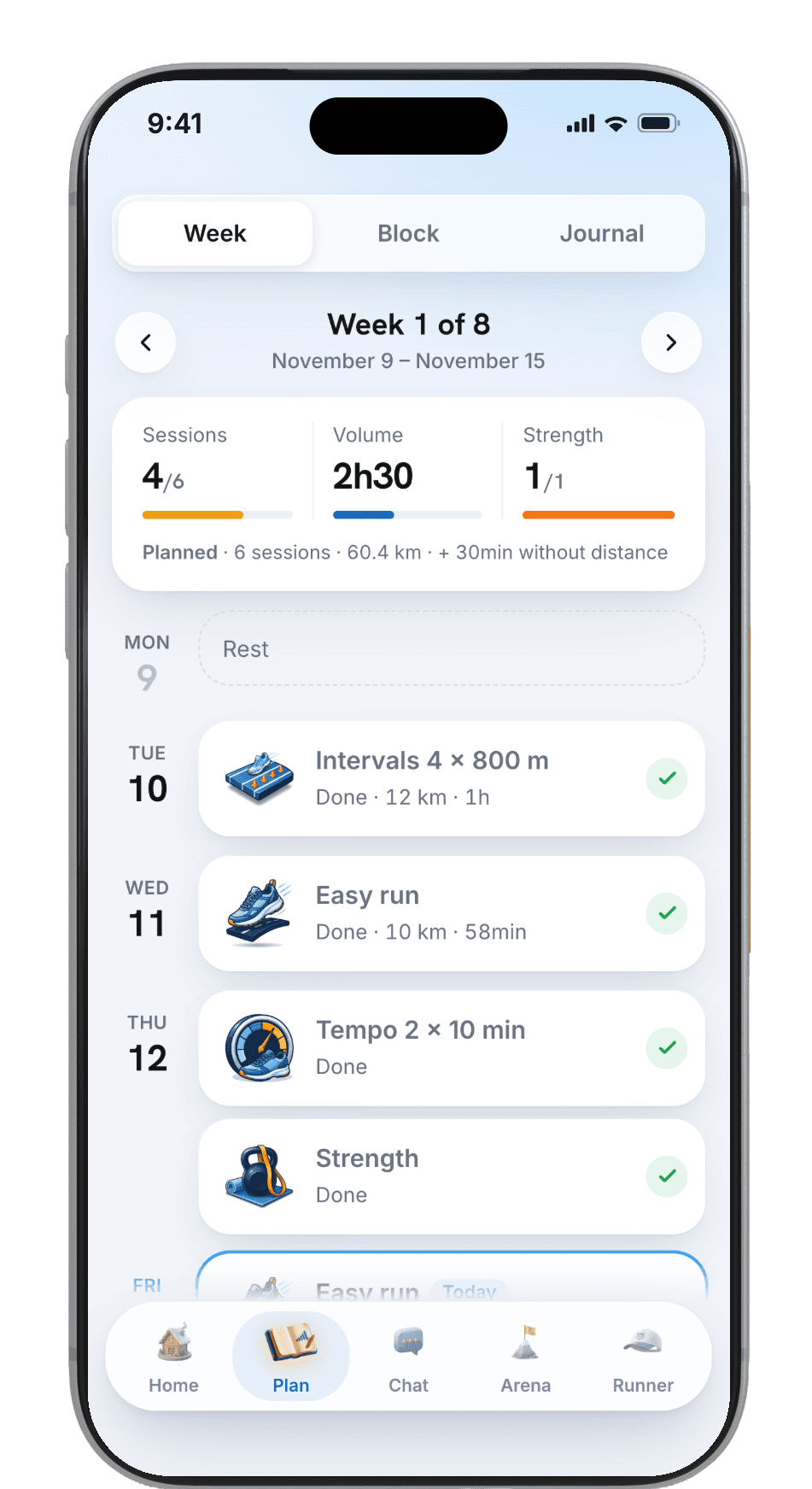
Every session, day by day. Expand a week to see it. Paces and durations are those of the sample plan: with Leo, they start from your own runs.
Base · Week 141 km
Mon
Easy
7 km easy @ 4:47–5:48/km
Tue
Rest
Full rest or cross-training
Wed
Easy
7 km easy @ 4:47–5:48/km
Thu
Rest
Full rest or cross-training
Fri
Easy
8 km easy @ 4:47–5:48/km
Sat
Easy
7 km easy @ 4:47–5:48/km
Sun
Long
12 km steady @ 4:47–5:48/km
Something comes up this week, or your paces change? With Leo, the plan follows your runs, from your watch or Strava. Try 7 days free →
Base · Week 251 km
Mon
Easy
9 km easy @ 4:47–5:48/km
Tue
Rest
Full rest or cross-training
Wed
Easy
10 km easy @ 4:47–5:48/km + 6 × 20 s strides
Thu
Rest
Full rest or cross-training
Fri
Easy
10 km easy @ 4:47–5:48/km
Sat
Easy
9 km easy @ 4:47–5:48/km
Sun
Long
13 km steady @ 4:47–5:48/km
Something comes up this week, or your paces change? With Leo, the plan follows your runs, from your watch or Strava. Try 7 days free →
Build · Week 351 km
Mon
Rest
Full rest or cross-training
Tue
Threshold
Warm-up + 3–4 × 8 min @ threshold 4:06–4:17/km (90 s jog) + cool-down
Wed
Recovery
7 km very easy @ 5:48/km, or rest
Thu
Intervals
Warm-up + 5–6 × 1000 m @ 3:46–3:51/km, equal jog recovery + cool-down
Fri
Rest
Full rest or cross-training
Sat
Easy
7 km easy @ 4:47–5:48/km
Sun
Long
15 km steady @ 4:47–5:48/km
Something comes up this week, or your paces change? With Leo, the plan follows your runs, from your watch or Strava. Try 7 days free →
Build · Week 4deload (recovery week)45 km
Mon
Rest
Full rest or cross-training
Tue
Threshold
Warm-up + 3–4 × 8 min @ threshold 4:06–4:17/km (90 s jog) + cool-down
Wed
Recovery
5 km very easy @ 5:48/km, or rest
Thu
Intervals
Warm-up + 5–6 × 1000 m @ 3:46–3:51/km, equal jog recovery + cool-down
Fri
Easy
5 km easy @ 4:47–5:48/km
Sat
Easy
5 km easy @ 4:47–5:48/km
Sun
Long
16 km steady @ 4:47–5:48/km
Something comes up this week, or your paces change? With Leo, the plan follows your runs, from your watch or Strava. Try 7 days free →
Build · Week 558 km
Mon
Rest
Full rest or cross-training
Tue
Threshold
Warm-up + 3–4 × 8 min @ threshold 4:06–4:17/km (90 s jog) + cool-down
Wed
Recovery
6 km very easy @ 5:48/km, or rest
Thu
Intervals
Warm-up + 5–6 × 1000 m @ 3:46–3:51/km, equal jog recovery + cool-down
Fri
Easy
6 km easy @ 4:47–5:48/km
Sat
Easy
7 km easy @ 4:47–5:48/km
Sun
Long
17 km steady @ 4:47–5:48/km
Something comes up this week, or your paces change? With Leo, the plan follows your runs, from your watch or Strava. Try 7 days free →
Build · Week 661 km
Mon
Rest
Full rest or cross-training
Tue
Threshold
Warm-up + 3–4 × 8 min @ threshold 4:06–4:17/km (90 s jog) + cool-down
Wed
Recovery
7 km very easy @ 5:48/km, or rest
Thu
Intervals
Warm-up + 5–6 × 1000 m @ 3:46–3:51/km, equal jog recovery + cool-down
Fri
Easy
6 km easy @ 4:47–5:48/km
Sat
Easy
7 km easy @ 4:47–5:48/km
Sun
Long
19 km steady @ 4:47–5:48/km
Something comes up this week, or your paces change? With Leo, the plan follows your runs, from your watch or Strava. Try 7 days free →
Peak · Week 763 km
Mon
Rest
Full rest or cross-training
Tue
Tempo
Warm-up + 20–25 min continuous @ threshold 4:06–4:17/km + cool-down
Wed
Recovery
7 km very easy @ 5:48/km, or rest
Thu
Intervals
Warm-up + 5–6 × 1000 m @ 3:46–3:51/km, equal jog recovery + cool-down
Fri
Easy
7 km easy @ 4:47–5:48/km
Sat
Easy
7 km easy @ 4:47–5:48/km
Sun
Long
20 km steady @ 4:47–5:48/km
Something comes up this week, or your paces change? With Leo, the plan follows your runs, from your watch or Strava. Try 7 days free →
Peak · Week 864 km
Mon
Rest
Full rest or cross-training
Tue
Tempo
Warm-up + 20–25 min continuous @ threshold 4:06–4:17/km + cool-down
Wed
Recovery
7 km very easy @ 5:48/km, or rest
Thu
Intervals
Warm-up + 5–6 × 1000 m @ 3:46–3:51/km, equal jog recovery + cool-down
Fri
Easy
7 km easy @ 4:47–5:48/km
Sat
Easy
7 km easy @ 4:47–5:48/km
Sun
Long
21 km steady @ 4:47–5:48/km
Something comes up this week, or your paces change? With Leo, the plan follows your runs, from your watch or Strava. Try 7 days free →
Peak · Week 966 km
Mon
Rest
Full rest or cross-training
Tue
Tempo
Warm-up + 20–25 min continuous @ threshold 4:06–4:17/km + cool-down
Wed
Recovery
7 km very easy @ 5:48/km, or rest
Thu
Intervals
Warm-up + 5–6 × 1000 m @ 3:46–3:51/km, equal jog recovery + cool-down
Fri
Easy
7 km easy @ 4:47–5:48/km
Sat
Easy
7 km easy @ 4:47–5:48/km
Sun
Long
23 km steady @ 4:47–5:48/km
Something comes up this week, or your paces change? With Leo, the plan follows your runs, from your watch or Strava. Try 7 days free →
Peak · Week 1068 km
Mon
Rest
Full rest or cross-training
Tue
Tempo
Warm-up + 20–25 min continuous @ threshold 4:06–4:17/km + cool-down
Wed
Recovery
7 km very easy @ 5:48/km, or rest
Thu
Intervals
Warm-up + 5–6 × 1000 m @ 3:46–3:51/km, equal jog recovery + cool-down
Fri
Easy
7 km easy @ 4:47–5:48/km
Sat
Easy
8 km easy @ 4:47–5:48/km
Sun
Long
24 km steady @ 4:47–5:48/km
Something comes up this week, or your paces change? With Leo, the plan follows your runs, from your watch or Strava. Try 7 days free →
Something comes up this week, or your paces change? With Leo, the plan follows your runs, from your watch or Strava. Try 7 days free →
Common mistakes when targeting Sub-1:30
These are the recurring errors we see in runners aiming for Sub-1:30. Avoiding them is often the difference between PR and DNF.
01
Running easy days too fast. Your easy pace should feel conversational (4:15/km is your race pace — easy is much slower). Running easy days at marathon pace burns you out without aerobic adaptation gain.
02
Skipping the taper. The last 2-3 weeks of reduced volume are not 'rest' — they are when adaptation consolidates and glycogen restores. Adding miles in the taper is the most common pre-race mistake.
03
Treating the long run as a competition. The long run builds endurance, not race-day capability. Keep it relaxed (slow side of easy pace). If you are 'spent' the day after, you ran it too fast.
04
Stacking intensity to compensate for missed sessions. If you miss a session, let it go. Trying to 'make it up' next week by doubling intensity is the fastest path to injury at this level.
05
Underestimating recovery between hard sessions. Plan at least two easy or rest days between intensity workouts (intervals, threshold, marathon pace). The 'cumulative fatigue' Hansons approach is the only exception, and it's only for advanced runners.
1 / 5
Race day: Half-marathon in Sub-1:30
Plan on 4:13/km on the course markers: 5 km in 21:05, 10 km in 42:10, 15 km in 1:03:15, finish around 1:29:00. That leaves about a minute for a first kilometre slowed by the crowd. Take a gel ten minutes before the start and, if you tolerate it, a second one around km 10; a few mouthfuls of water at two stations are enough. If 1:30 flat rather than under is your target, the plan does not change; only that minute of margin disappears. Sub-1:30 races are often lost in the wind between km 8 and 16, when packs break up and runners end up alone at 4:15/km. Stay with a group, even one running two seconds per kilometre slower than you wanted.
Even-pace split times (4:15/km)
Checkpoint
Time
5 km
21:20
10 km
42:39
15 km
1:03:59
20 km
1:25:18
21.0975 km
1:29:59
Frequently asked questions
Is training for a 1:30 half the same as training for sub-1:30?
Yes. One second per kilometre separates the two paces, 21 seconds over the race, and no session in the plan changes for that. What changes is how you start. Aiming at 1:29 leaves room for a crowded first kilometre and for a watch that measures the course 100 to 200 metres long. Aiming at 1:30 flat removes that room, so the first 2 km have to be on pace straight away.
Should I do VO2max intervals for a sub-1:30 half?
Some, but they are not the core of the plan. Short intervals at 3:46 to 3:51/km, typically 5 × 1 km with 2 minutes of jogging, come about once every ten days during the build phase. They raise the ceiling above your race pace. From week 7 onwards they give way to threshold and race-pace work, because that is where a half at 4:15/km is decided.
How long should my long run be for a sub-1:30 half marathon?
Up to 24 km, slightly longer than the race. At 4:50 to 5:15/km that is around two hours, enough to make 90 minutes at threshold feel short on the day. In the peak phase some long runs end with 3 to 5 km at 4:15 to 4:20/km. Going beyond 24 km adds little for a half and takes too long to recover from inside a 12-week block.
Sources & methodology
This sample plan draws on the principles of the major training methods, documented and tested over decades:
Pete Pfitzinger — Advanced Marathoning (3rd ed., 2019)
Leo Training does not replace medical advice. Consult a sports physician before starting any new training plan, especially after an injury or extended break.
This plan is the same for everyone. Leo writes yours from your runs, your week and your goal, then adjusts it when life gets in the way: a missed session, a tiring week, a trip.