
Strength training for runners: what actually works
TL;DR
Two strength sessions a week on top of your running make your stride more economical: Blagrove's 2018 systematic review reports running economy improving by 2 to 8 %, and recent meta-analyses confirm the effect of heavy loads and plyometrics. The dose drops as the race gets closer: one maintenance session at peak, one light activation session in the taper. What the research does not show is that a strength programme on its own prevents injuries in runners.
What strength work actually does for a runner
The best-established benefit is running economy: at the same pace, you spend less energy. The systematic review by Blagrove and colleagues (2018) reports economy improving by 2 to 8 %, along with better time-trial results and speed, and no meaningful change in body composition. Both 2024 meta-analyses by Llanos-Lagos point the same way: heavy loads, plyometrics and their combination improve economy, and heavy loads improve time-trial performance. The second argument is coaching common sense more than trial evidence: stronger muscles and tendons cope better with the weeks when volume climbs. Those two reasons are why Leo puts strength work in your plan.
Heavy or light? The loads that make the difference
Contrary to a common runner's instinct, light sets of twenty reps are not the most useful. Eihara's 2022 meta-analysis, which compares the two approaches head to head, finds a clearer effect of heavy resistance training than of plyometrics on both running economy and time trials, and a larger one still with near-maximal loads. Llanos-Lagos (2024) adds that plyometrics keep their value at slower speeds, while heavy loads pay off most at faster speeds; submaximal loads and isometrics look less effective. For general prescription, Currier's 2023 network meta-analysis, run on healthy adults rather than runners, shows that any prescription beats none and that heavy loads over several sets maximise strength. Heavy does not mean from week one: technique and tolerance come first, with single-leg exercises and slow lowering phases.
How many sessions, and when in the build
Two sessions a week during the base and build phases, in line with the two to three a week Blagrove recommends. At peak, a single maintenance session, short and heavy, with a little plyometric work. In the taper, one light activation session (hips, trunk), nothing that leaves you sore. That is where Leo starts, not a ceiling: if you want to do more, Leo adds sessions and keeps the recovery your key runs need. A session takes 25 to 40 minutes. The best slot is the same day as a hard run, after it, so your easy days stay truly easy. Loaded exercises stop earlier before a long race, up to two weeks before a marathon, and nothing at all happens in the last three days.
Which exercises, and what for
Leo's catalogue holds 46 exercises, 25 of them with no equipment at all. The sessions draw on what running asks of the body: one leg at a time (Bulgarian split squat, step-up, single-leg deadlift), the calves and the soleus, the hamstrings braking with the Nordic curl, the adductors with the Copenhagen plank, and the trunk. The Nordic and the Copenhagen have the best prevention data, but it comes from team sports: programmes that include the Nordic roughly halve hamstring injuries (van Dyk, 2019, 8,459 athletes), and the Copenhagen plank cut the risk of groin problems by 41 % in football players (Harøy, 2019). None of these studies was run on runners.
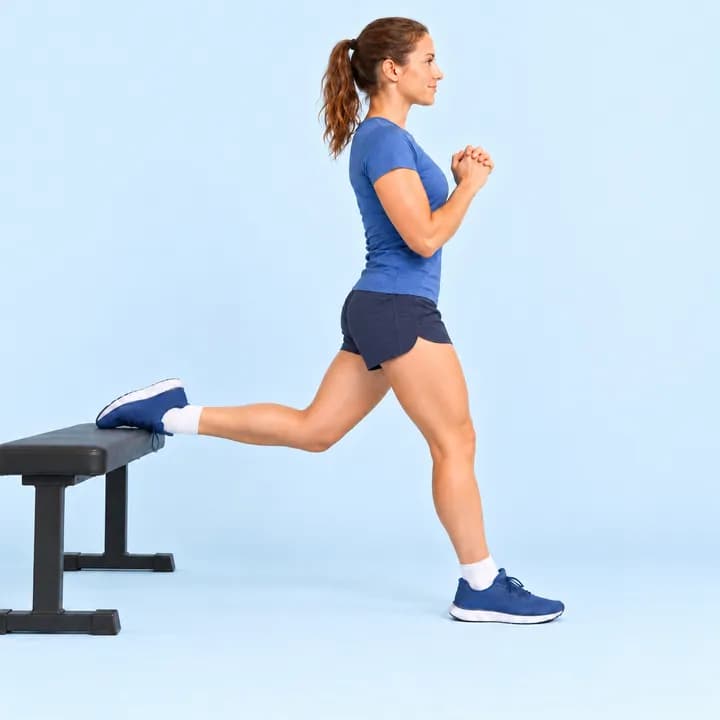 Start
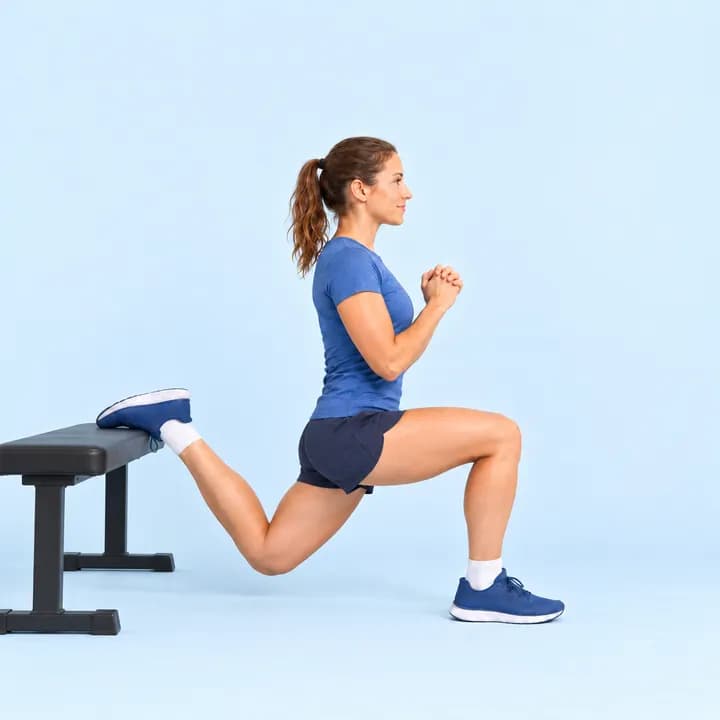 End
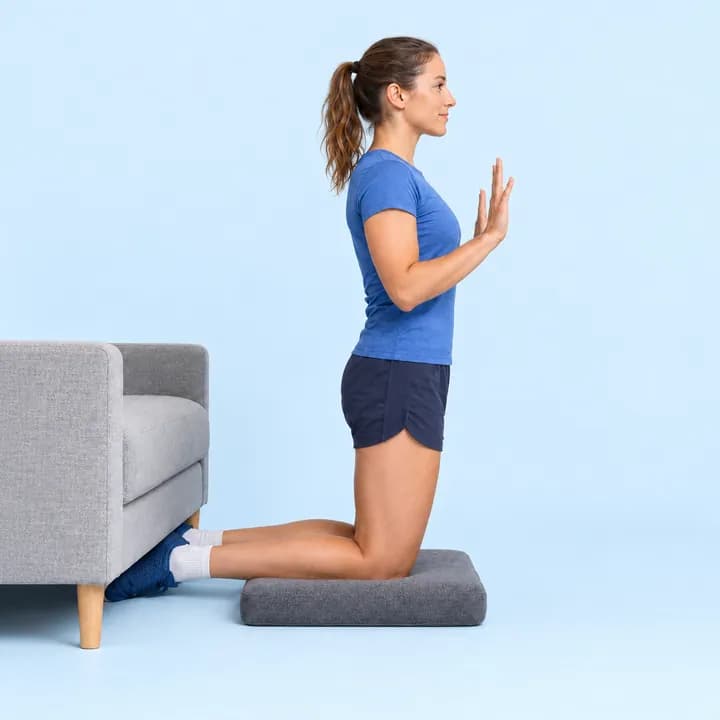 Start
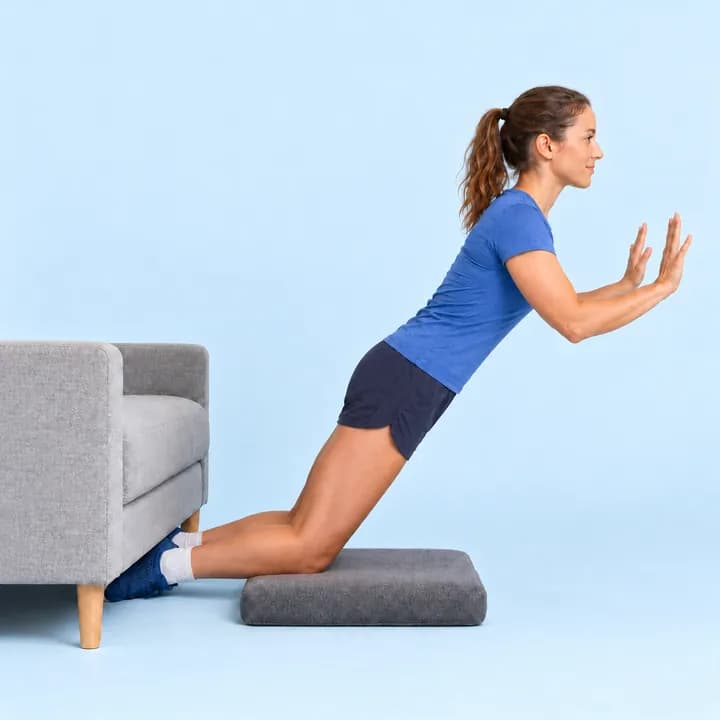 End
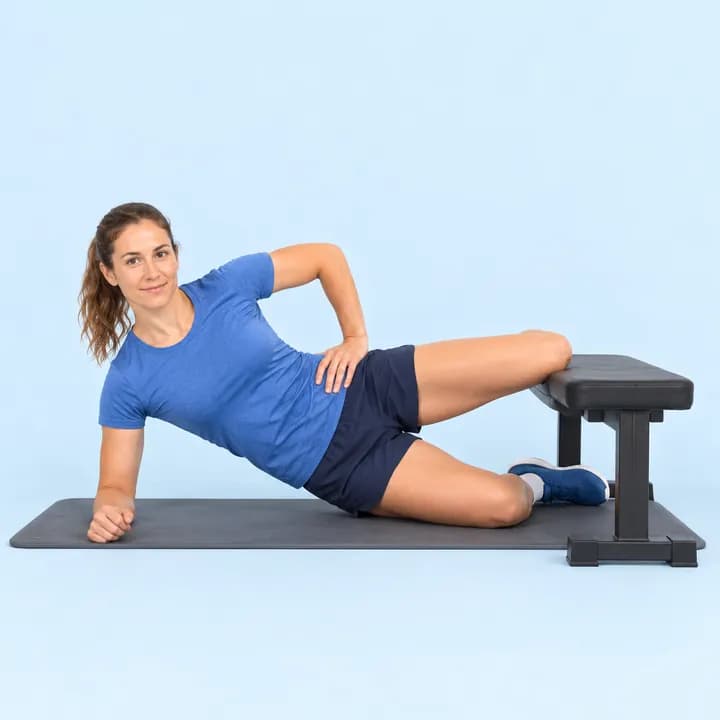 Start
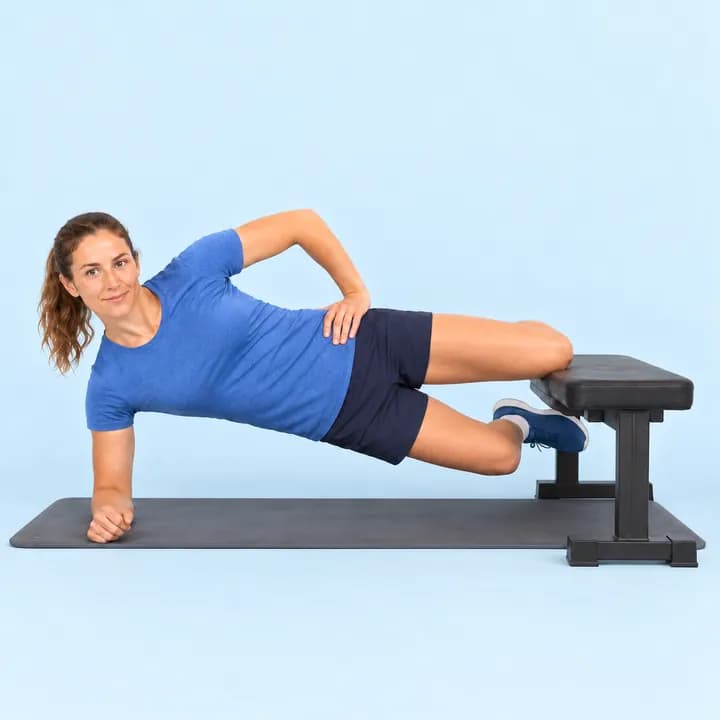 End
What about injuries?
It is the argument you hear everywhere, and the one the research supports least in runners. Wu's 2024 meta-analysis, which only keeps trials run on endurance runners, concludes that current evidence is not enough to recommend exercise-based programmes to reduce running injuries; an effect only shows up for supervised programmes, in a secondary analysis. So Leo will not promise you strength work that prevents injuries. It offers strength work that makes you run better and helps you absorb the load of a build.
How Leo builds it into your plan
Leo places the strength sessions in your week according to the phase of your build, and the exercises are picked from the equipment you have: nothing, a band, a kettlebell, dumbbells or a gym. Each exercise comes with a short sheet: start and end photos, the movement, three key points, the mistake to avoid, an easier and a harder version, and when to stop. If pain shows up somewhere, the exercises that load that area leave the next sessions. A session is ticked off in one tap, or on its own when your watch records it. Strength work is part of a triathlon build too, and you can see how it fits with the taper.
Sources
- Blagrove RC et al. (2018). Effects of Strength Training on the Physiological Determinants of Middle- and Long-Distance Running Performance: A Systematic Review. Sports Medicine. doi:10.1007/s40279-017-0835-7
- Llanos-Lagos et al. (2024). Effect of Strength Training Programs in Middle- and Long-Distance Runners' Economy: Systematic Review with Meta-analysis. Sports Medicine. doi:10.1007/s40279-023-01978-y
- Llanos-Lagos et al. (2024). The Effect of Strength Training Methods on Middle-Distance and Long-Distance Runners' Athletic Performance: A Systematic Review with Meta-analysis. Sports Medicine. doi:10.1007/s40279-024-02018-z
- Eihara Y et al. (2022). Heavy Resistance Training Versus Plyometric Training for Improving Running Economy and Running Time Trial Performance: A Systematic Review and Meta-analysis. Sports Medicine - Open. doi:10.1186/s40798-022-00511-1
- Currier BS et al. (2023). Resistance training prescription for muscle strength and hypertrophy in healthy adults: a systematic review and Bayesian network meta-analysis. British Journal of Sports Medicine. doi:10.1136/bjsports-2023-106807
- van Dyk N, Behan FP, Whiteley R (2019). Including the Nordic hamstring exercise in injury prevention programmes halves the rate of hamstring injuries: a systematic review and meta-analysis of 8459 athletes. British Journal of Sports Medicine. doi:10.1136/bjsports-2018-100045
- Harøy J et al. (2019). The Adductor Strengthening Programme prevents groin problems among male football players: a cluster-randomised controlled trial. British Journal of Sports Medicine. doi:10.1136/bjsports-2017-098937
- Wu H et al. (2024). Do Exercise-Based Prevention Programs Reduce Injury in Endurance Runners? A Systematic Review and Meta-Analysis. Sports Medicine. doi:10.1007/s40279-024-01993-7
Frequently asked questions
How many strength sessions a week should a runner do?
Two in general while the build is growing, one at peak, and one light activation session during the taper. Blagrove's 2018 review recommends two to three sessions a week, mixing types of work. If you want more, Leo adds them and protects the recovery before your key runs.
Does strength training prevent running injuries?
Not in a proven way in runners. Wu's 2024 meta-analysis finds no overall drop in injuries with exercise programmes alone; only supervised programmes show an effect, in a secondary analysis. The proven benefit is running economy.
Do I need a gym?
No. Of the 46 exercises in Leo's catalogue, 25 need no equipment. A gym or a kettlebell lets you move towards heavier loads, which give the clearest effects on running economy.
Heavy or light: which is better for runners?
Heavy, once the technique is in place: few reps, several sets. Llanos-Lagos (2024) finds moderate loads and isometrics less effective on running economy than heavy loads and plyometrics.
Can I do strength work in race week?
Yes, but light: hip activation and trunk work, nothing that leaves you sore. Loaded exercises stop up to two weeks before a long race, and nothing happens in the last three days.
Strength work that follows your build
Leo places your strength sessions according to the phase of your plan, picks the exercises from the equipment you have and lightens everything before the race.
Start with 7 days free7 days free, then full access to Leo from 6.67/month (yearly) or 9.99/month. Nothing charged before day seven, cancel in one tap.
Keep going
General information, not medical advice. Consult a sports physician for injury or health concerns.
All guides →